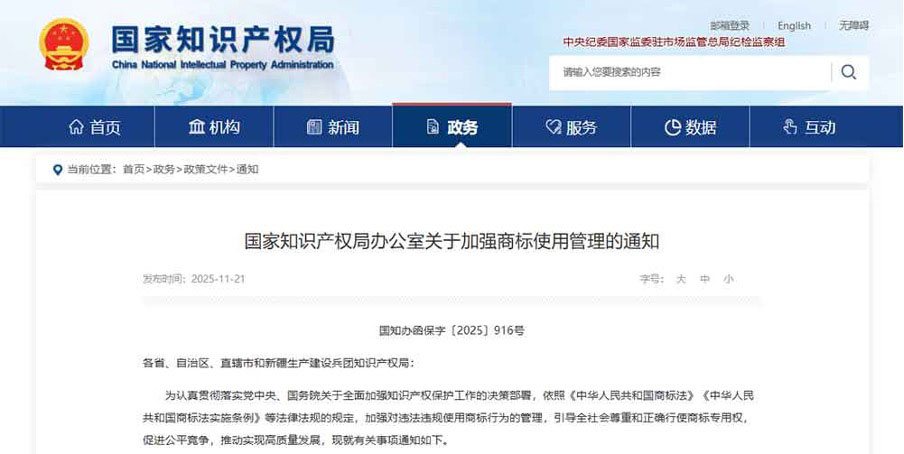
On November 21, 2025, China's National Intellectual Property Administration (CNIPA) released the Notice from the General Office of the CNIPA on Strengthening the Management of Trademark Use (国家知识产权局办公室关于加强商标使用管理的通知). Objectives include "to use trademarks in a reasonable and standardized manner, continuously strengthen the supervision and governance of illegal and irregular use of trademarks, strictly regulate behaviors that deceive and mislead the public through false descriptions using trademarks, resolutely safeguard the legitimate and orderly order of trademark use, effectively protect the interests of consumers and producers and operators, actively create a market environment of honest operation and fair competition, and help build a unified national market."
CNIPA will watch for the following illegal and irregular activities:
(i) Use of prohibited unregistered trademarks that are deceptive. Special attention will be paid to the use of unregistered trademarks containing terms such as "exclusively supplied," "specially supplied," "premium," or "national," which may mislead the public about the supply channels or quality of goods; the use of unregistered trademarks containing terms such as "selenium-rich," "organic," "zero additives," or "100%," where the actual attributes of the goods do not match these terms, leading to public misconceptions about the main raw materials, ingredients, or other characteristics of the goods; and the use of unregistered trademarks containing place names, years, or terms such as "handmade" or "hand-made," which may mislead the public about the origin, production time, or production process of the goods.
(ii) Deceptive use of registered trademarks. The focus is on acts that combine registered trademarks with product names, advertising slogans, product packaging, etc., causing the public to misunderstand the characteristics of product quality, origin, craftsmanship, etc.; acts that unilaterally change the registered information, causing the public to misunderstand the characteristics of product quality, etc., or acts that unilaterally change the registered information in order to exploit the trademarks of others.
(iii) Misuse of registered trademarks. The focus is on acts of marking registered trademarks or indicating registered trademarks on unregistered trademarks in a deceptive manner.
(iv) Failure to use registered trademarks when required. Special attention should be paid to the tobacco sector, particularly new tobacco products such as e-cigarettes.
(v) Prominent use of the term "well-known trademark" in commercial activities. Special attention will be paid to the use of the term "well-known trademark" with a recognized record in advertising and promotion.
(vi) Unauthorized use of collective trademarks and certification marks. Special attention will be paid to instances where goods using collective trademarks or certification marks fail to meet the quality requirements stipulated in the usage management rules.
(vii) Illegal agency practices by trademark agencies. Special attention will be paid to trademark agencies and their employees engaging in malicious trademark registration applications, malicious "cancellation for non-use," and other acts that harm the interests of trademark owners.
Measures include:
(i) Improve the working mechanism. It is necessary to establish and improve the division of labor and cooperation mechanism with the State Administration for Market Regulation (SAMR), improve the reporting and acceptance mechanism for illegal and irregular use of trademarks, unblock reporting channels, strengthen linkage, and form a joint force.
(i) Conduct targeted investigations. We must strengthen daily supervision and public opinion monitoring, focusing on areas closely related to the vital interests of the people, such as food and drugs, children's toys, and household appliances. We must promptly identify illegal activities and improper behaviors, such as using trademarks to deceive or mislead consumers, and intensify efforts in trademark use management and law enforcement guidance.
(III) Timely handling of leads. Leads on illegal or irregular use of trademarks and other illegal activities that disrupt the trademark agency market order through improper means should be promptly reported to SAMR and law enforcement team for investigation and handling in accordance with laws and regulations. Leads on cross-regional cases can be reported to the higher-level intellectual property management department for coordination and handling.
(iv) Strengthen compliance guidance. We should strengthen publicity and education for producers and operators to ensure the quality of their goods and services, maintain trademark reputation, abandon speculative mentality, and operate with integrity; in the relevant policies on trademark protection and use, we should strengthen the requirements for the compliant use of trademarks and positively guide enterprises to use trademarks in compliance.
(V) Strengthen comprehensive governance. It is necessary to strengthen the supervision of trademark agencies, give full play to the role of industry associations, and encourage trademark agencies to proactively convey the concept of correct application and use of trademarks to applicants; strengthen credit supervision, and carry out credit punishment work in accordance with laws and regulations for all kinds of entities that violate the law and cause serious consequences.
(vi) Create a favorable atmosphere. We should increase publicity on trademark laws and regulations, promptly summarize typical cases and experiences formed in trademark use and management, and actively create a favorable atmosphere in the whole society for respecting and correctly exercising trademark rights.
Source:
https://www.chinaiplawupdate.com/2025/11/chinas-national-intellectual-property-administration-to-strengthen-management-of-trademark-use/ (English)

Stay IP to date