

"Recent decisions from Chinese courts signal a clear judicial stance on the limits of using artificial intelligence as a basis for workforce restructuring. In particular, courts are increasingly scrutinising dismissals and salary adjustments justified on the grounds of technological upgrades.\n\nIn a notable case before the Hangzhou Intermediate People\u2019s Court, an employee at a fintech company was demoted and subjected to a substantial salary reduction following the introduction of AI systems. After the employee refused to accept these changes, the company terminated his employment, citing operational transformation. Both the arbitral tribunal and the court found the dismissal unlawful, emphasising that unilateral changes to core employment terms\u2014particularly where accompanied by significant pay cuts\u2014cannot be justified solely by internal technological developments.\n\nSimilarly, in a Guangzhou case involving a graphic designer whose role was replaced by AI tools, the court held that the adoption of new technology does not constitute a \u201cmaterial change in objective circumstances\u201d under Chinese labour law. As such, it cannot serve as a standalone legal basis for termination.\n\nTaken together, these decisions reinforce a consistent principle: employers may not transfer the commercial risks of digital transformation onto employees. Courts have underscored that any adjustment to roles or remuneration must be grounded in fair consultation and mutual agreement, and that substantial reductions in compensation are unlikely to be considered reasonable.\n\nThese rulings arise against the backdrop of broader policy discussions in China regarding the societal impact of AI on employment. Policymakers and academic commentators have proposed enhanced regulatory oversight, including pre-deployment employment impact assessments and ongoing monitoring mechanisms for AI adoption.\n\nAt the regulatory level, Chinese authorities are also moving towards a more structured response. Recent policy developments include plans to establish an AI-related employment monitoring and early warning system, as well as the integration of AI impact assessments into national economic planning frameworks under the forthcoming Five-Year Plan.\n\nFor businesses operating in China, these developments highlight the importance of carefully managing AI-driven transitions, ensuring compliance with labour laws, and adopting a balanced approach that aligns technological innovation with employee protections.\n\nSource:https://chinaipr.mofcom.gov.cn/article/cases/202605/1996025.html (English)"
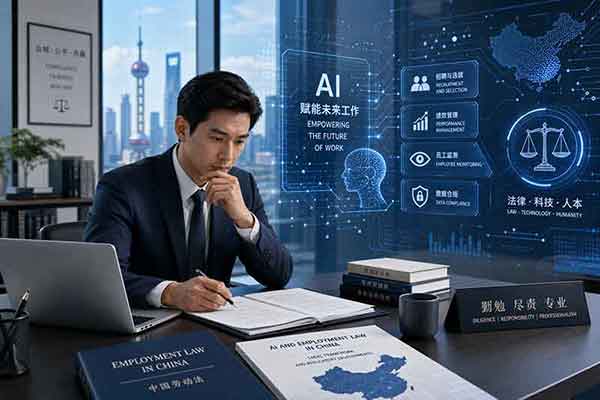
Chinese courts clarify limits on AI-Driven workforce restructuring
China IP News | Innovation-and-technology
← Back to BlogBack to Top