

"Global AI governance is increasingly moving from principle-based frameworks to practical implementation. China\u2019s approach stands out for its targeted and responsive regulation, addressing specific risks as they emerge rather than relying on a single overarching law.\n\nInitial regulatory efforts focused on algorithmic recommendation systems widely used by digital platforms. As concerns grew around information manipulation, unfair competition and opaque decision-making, China introduced the 2022 Provisions on Algorithm Recommendations. These rules established obligations such as algorithm filing, security assessments and risk monitoring, focusing on how algorithms operate in practice.\n\nRegulation soon expanded to deep synthesis technologies, including tools capable of generating realistic audio-visual content. The 2022 Deep Synthesis Provisions introduced requirements such as content labelling and strengthened accountability across service providers, technology developers and users to address risks such as misinformation and identity misuse.\n\nThe emergence of generative AI added further complexity due to its broad and multi-purpose applications. The Interim Measures on Generative AI Services (2023) adopt a flexible approach, focusing on content governance while allowing room for continued technological development. Subsequent measures in 2025 further reinforced content labelling as a core regulatory requirement.\n\nMore recently, attention has turned to anthropomorphic AI systems, such as virtual companions and conversational agents. The 2026 Interim Measures in this area emphasise transparency, requiring clear disclosure of AI identity, and introduce enhanced protections for vulnerable groups, reflecting concerns around emotional dependency and user manipulation.\n\nOverall, China\u2019s regulatory model is characterised by three key features: it is problem-driven, application-focused and iterative. Rather than defining AI in a single framework, regulators respond to specific use cases and refine rules over time.\n\nFor businesses, this approach highlights the need to track regulatory developments closely and assess compliance at the level of specific technologies and applications.\n\nSource:https://www.chinadaily.com.cn/a/202604/28/WS69f099e8a310d6866eb46053.html\n\n(English)"
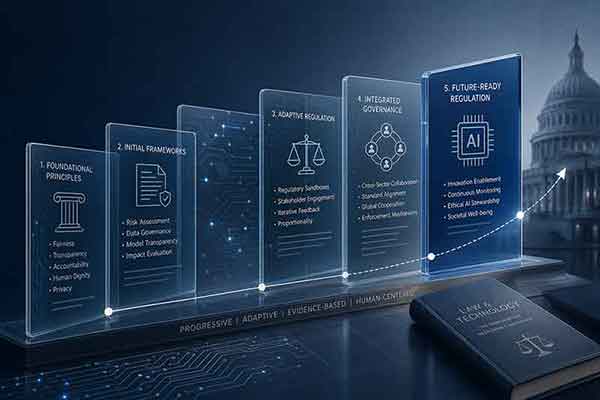
Progressive AI regulation
China IP News | Innovation-and-technology
← Back to BlogBack to Top