

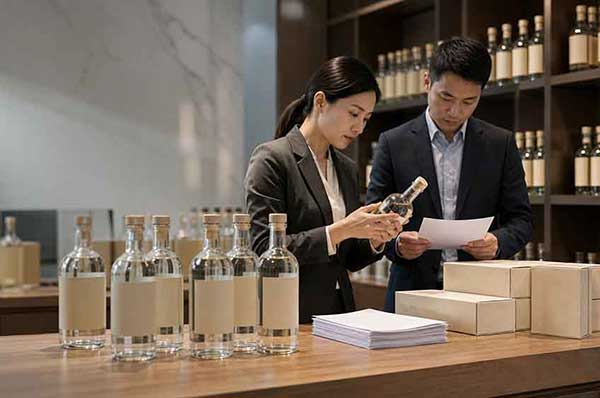
On August 11, 2026, the Beijing Administration for Market Regulation (AMR) published the Second Batch of Typical Cases in the Special Rectification Campaign Targeting Prominent Food Safety Issues-Special Column on Typical Cases Involving the Sale of Counterfeit Baijiu, which includes the following cases.
·Case 1: Chaoyang AMR investigated and handled a case involving the sale of baijiu bearing counterfeit registered trademarks and failure to implement the food purchase inspection system
Based on a tip-off from local citizens, the AMR in Chaoyang District conducted an inspection of a liquor company.
The inspection found that the party concerned had purchased four bottles of baijiu with the name of “Xijiu Jiaocang 1988 (New Version) sauce aroma” from an individual at a price of RMB 300 per bottle. When purchasing the liquor, the party failed to inspect the supplier's qualifications and the product conformity certificates and also failed to establish and retain purchase inspection records as required
The party subsequently sold the four bottles through an online store at RMB 350 per bottle. One bottle could not be authenticated because the reporter was unable to provide the physical product. The remaining three bottles were identified by the trademark owner as counterfeit liquor.
The AMR in Chaoyang District ordered the party to rectify all unlawful conduct and imposed an administrative penalty consisting of a warning and a fine.
Case 2: Yanqing AMR investigated and handled a case involving two instances of selling counterfeit goods within five years and failure to perform food purchase inspection obligations
Based on a tip-off, the AMR in Yanqing District inspected a supermarket and seized eight bottles of baijiu with the name of “Niulanshan” on site. All eight bottles were identified by the trademark owner as counterfeit goods.
The investigation found that the supermarket had purchased the liquor involved at a low price from door-to-door salespersons and had failed to inspect or retain the supplier’s qualification documents, purchase vouchers, or product conformity certificates.
The party’s conduct constituted both trademark infringement through the sale of goods infringing the exclusive right to use a registered trademark and a failure to fulfil the required food purchase inspection and record-keeping obligations.
Because the party had previously been penalised in 2025 for selling trademark-infringing goods, the present conduct constituted a repeated violation of the same type within five years. Accordingly, a heavier penalty was imposed in accordance with law.
The AMR in Yanqing District ordered the party to cease the infringement and imposed an administrative penalty consisting of a warning, confiscation of the infringing liquor, and a fine.
Case 3: Fangshan AMR investigated and handled a case involving the sale of baijiu bearing counterfeit registered trademarks
Following a complaint from local citizens, the AMRin Fangshan District carried out an enforcement inspection of a food company within its jurisdiction suspected of selling counterfeit baijiu.
The investigation found that the party had sold 76 bottles of baijiu with the name of “Niulanshan” and 9 bottles of baijiu with the name of “Jiannanchun”. When purchasing the products, the party failed to inspect the supplier’s license and conformity certification documents and failed to establish and implement the food purchase inspection and record-keeping system. All of the liquor products concerned were identified by the respective trademark owners as counterfeit.
The AMR in Fangshan District imposed an administrative penalty consisting of a warning, confiscation of the infringing liquor, and a fine.
Source:
https://scjgj.beijing.gov.cn/zwxx/scjgdt/202608/t20260811_4817510.html